
You may have a fat budget that you can rely on for paid advertisements on search engines like Google and Bing. But you can do that for months and not really make much money. Worse than that is the fact that once your paid ads campaigns are off, no one can find you. This is why businesses and entrepreneurs also put in their organic efforts. They know it’s an effort that will pay off in the long run.
Justifiably, seo takes longer than paid marketing for you to get substantial results. With paid ads, you can get instant results, but that’s not the case all of the time. The competition is high and you can end up exhausting your resources quickly, with your brand being left nowhere.
Wouldn’t it just be wiser to have a thriftier ad spend while populating the digital space with content that can last many months if not years. It’s not like you won’t pay a dime for organic marketing. If you don’t spend time writing content and design assets yourself, you will need to pay people you hire for these roles. However, the amount you invest in these efforts is arguably way more cost-effective. So let’s try and understand more about how organic growth is a mandatory part of the marketing blend you need for your brand alongside paid advertisements.
How Long Does It Take To Rank On Search Engines Through Seo?
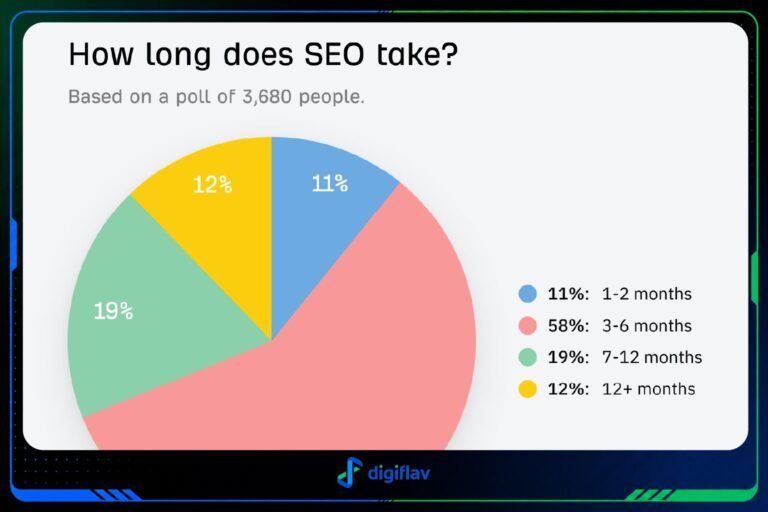
Any SEO marketer will generally tell you it takes around 3 to 6 months to achieve results you can gauge. In more competitive niches, it can take 12 months or more.
SEO typically takes three to six months to produce measurable results, and in competitive industries it can take six to 12 months to see significant ranking and revenue impact. The timeline depends on the age and authority of the website, how quickly SEO changes are implemented, and how long search engines take to crawl and reassess updated pages.
That said, momentum should be visible before results arrive, with clear indicators of progress along the way. For example, technical fixes or on-page optimizations can generate early gains within weeks, but sustainable growth in organic traffic is a cumulative process that builds over time.
How Long Does Seo Take: Factors That Play A Role?
One of the most important factors is your website age. That’s because, when you approach any organic marketing specialist, they like to know where your brand is at, when it got started, etc., since that helps them determine how much work is involved in ranking your brand. You must remember that results are custom, and comparing metrics of similar entities within a specific niche is often considered unfair.
Also, it’s well known that a new site will take some time to appear in search results compared to an older one. Sites that have been around for a long time, tend to have a structure already in existence and recognizable by search engine algorithms. So, those are naturally easier to rank quickly.
How Long Does Seo Take To Show Results?
While the response that search engine algorithms have to SEO efforts is reliant on website age and a host of factors along with that, there is also a human factor involved that can certainly influence the speed with which SEO changes take place. Making developmental changes to a site for SEO improvements is just one; if the technical administrators respond quickly, that’s in your favor.
On the flip side, if developmental changes take a long time and are slow, it’s not going to please the SEO team asking for these changes and the slow pace of work will mean waiting more than you need to.
How Long Does It Take Seo To Work?
How quickly do search engines like Google evaluate or re-evaluate your pages or site?
Once your technical team is done with the required changes, search engines will take a certain amount of time to go through those updates. This is referred to as ‘crawling,’ which can take time based on how they are structured and also because of the kind of content they may have on them. This process comprises checks for authority and site architecture.
If you have a vast site, comprising an abundance of pages that will take time to assess. Also, sites that usually take longer to crawl include those that are heavy with Javascript, have dynamic loading, client-end rendering, etc., may take time.
A key point to highlight here is the need for website owners and SEO technicians to understand is; where a given site stands based on the SEO factors involved.
With that said, there are several ranking factors, and covering them all in one write-up is out of the question. However, we have attempted to cover the main factors involved here.
Elements Of Search Engine Algorithms Processes
Before getting into listing the details here, it’s important to emphasize that all elements in your SEO journey are not controllable, as some like site crawling, rendering, etc. are known, algorithm updates themselves catch us by surprise.
Here’s a table showing different processes, what they are, and whether SEO teams can control them.
| Factor | What it is | Can SEO control it? |
| Major algorithm updates | Wide-ranging updates to search engine ranking mechanisms that impact search visibility across niches. | No |
| Periodical Re-ranking | Frequent re-evaluations where search engines reassess page rankings that are driven by based on fresh data inputs. | No |
| Crawl Timing and Depth | The frequency and depth with which the search engine bots assess a site for authority, size, and authenticity. | Partially |
| Preferential Indexing | The order and speed that search engines index new and updated pages. | Partially |
| Spam Alert | Search engine mechanisms that scan and detect unfair tactics. | Yes |
| Machine learning and search intent | An artificial Intelligence method of search engines assessing search intent to match relevant pages to their queries. | No |
| SERP layout and format testing | Search engine methods of evaluating various search result formats (examples include AI answers, snippets, etc) that play a role in visibility. | No |
While SEO teams can’t control most of these systems, they can control how well a site adheres to SEO best practices.
To name a few, SEO can control:
- Robust technical standingto make sure websites are crawled in a timely manner and evaluated with zero delays and technical issues.
- Thorough crawling and indexingto ensure main pages are explorable, correctly indexed, and aligned well for ranking in search results.
- Relevant and well-structured contentbased on a well-researched content strategy so that search engines comprehend and match the right pages with user intent.
- Relevant backlinkingto ensure search engines deem your site is authority and trustworthy.
- Proper site structurethat ensures authority and logic – these are based on search engine and internal links that help to identify important site pages.
How Long Does Seo Take To See Results?
While a lot of people even today tend to think of SEO rankings as easily achievable, they need to think again. On the flip side, while many people might think that SEO is out of their reach, nothing could be further from the truth. There is a whole lot of genuine effort that goes into SEO, and it must be handled carefully so that there are no mistakes that cost you your rankings.
This is especially important given the fact that a lot of things that were done and excused by search engines, aren’t permitted today. Things like keyword stuffing are a thing of the past, although some people even today feel they can get away with it. And the best part is that even readers are repulsed by such tactics, let alone search engines.
Yet, there are ways around keyword tactical details that have evolved since the early days of keyword stuffing; variations of keywords were introduced that created immense opportunity for SEO operatives, but also diversified the search landscape. Website owners could enhance their content and offer more engaging options based on long-tail keywords, broken keywords and whatnot.
With this, the flavor of content on websites began to evolve, with more and more original and creative content being encouraged. This has led to better quality, which is precisely what search engines demand, as it makes the search ecosystem something that users look forward to in terms of serving their purpose.
With the increasing demand for more purposeful information to be returned in search results, standards began to climb. Ordinary input for organic results no longer mattered, and the concept of EEAT took over. So now, websites must output content that reflects Experience, Expertise, Authoritativeness, and Trustworthiness. That just about comprises everything that anyone would need when they search for information be it, text, image or video.
With all things said, it seems that the demands are way higher than they ever were, and businesses began recruiting people who could help them provide their desired content. That makes one weigh the pros and cons between organic marketing and paid ads, because either way, you need to pay for results. However, with organic marketing, the results tend to last longer and have a deeper and wider impact. And that’s just as far as the content creation goes. There is indeed a whole lot more that is tied into this equation, and that refers to off page and technical approaches.
Now, in contrast to the organic efforts, which produce results that last longer, paid marketing tends to have a different sort of impact. With ads, you are more visible in an immediate scenario. This is incredibly powerful provided you know what your precise target is in terms of the market you’re looking to tap.
Planning a website, brand or SEO push?
Talk to the team behind this guide. We’ll map the fastest route for your business — no obligation.
✓ Response within 1 business day
✓ Free 45-minute discovery call
✓ Fixed estimates — no surprise invoices